Published Date
September 9, 2025
Industry
Information Technology
Category
Conversational AI
Challenge Faced
The client had a painful problem that's common across growing businesses: their website was getting decent traffic, but conversion rates were terrible. They were watching 70-80% of potential leads simply leave without any engagement whatsoever. Their traditional contact form sat there collecting dust because, let's be honest, nobody likes filling out forms. When people did submit the form, half the time they weren't even qualified prospects—just tire-kickers or people asking questions that had nothing to do with what the business actually offered.
The sales team was frustrated because they were spending hours each week chasing down unqualified leads, having the same repetitive conversations, asking basic discovery questions that could have been answered upfront. Meanwhile, serious buyers who visited the site after 6 PM or on weekends had nobody to talk to. They'd leave, probably to check out a competitor, and by Monday morning when someone finally followed up, that lead was ice cold.
The business was stuck in this inefficient loop: pay for traffic, watch most of it bounce, have the sales team waste time on bad leads, and miss out on after-hours opportunities. They needed a way to engage visitors immediately, qualify them intelligently before wasting sales time, and capture those precious after-hours leads that were currently evaporating.
Our Solution
I built an intelligent conversational AI that fundamentally changed how they capture and qualify leads. This isn't one of those annoying chatbots that just throws a bunch of FAQ links at you—this system actually has intelligent conversations with visitors, understands what they're looking for, determines if they're a good fit, and guides them naturally toward providing their contact information
Deep Technical Implementation-
Conversation Intelligence Engine- The core of this system is a sophisticated natural language understanding layer I built from scratch. It doesn't rely on rigid keyword matching or pre-defined conversation trees that break the moment someone says something unexpected. Instead, I implemented intent recognition that understands what users are really asking, even when they phrase things casually or vaguely. "Do you guys do custom integrations?" and "Can this work with our existing setup?" both trigger the same understanding—this person is asking about customization capabilities.
The system maintains conversation context across multiple exchanges, so it can have natural, flowing dialogues that feel human. When someone says "How much does that cost?" three messages into a conversation, the AI knows exactly what "that" refers to based on previous context
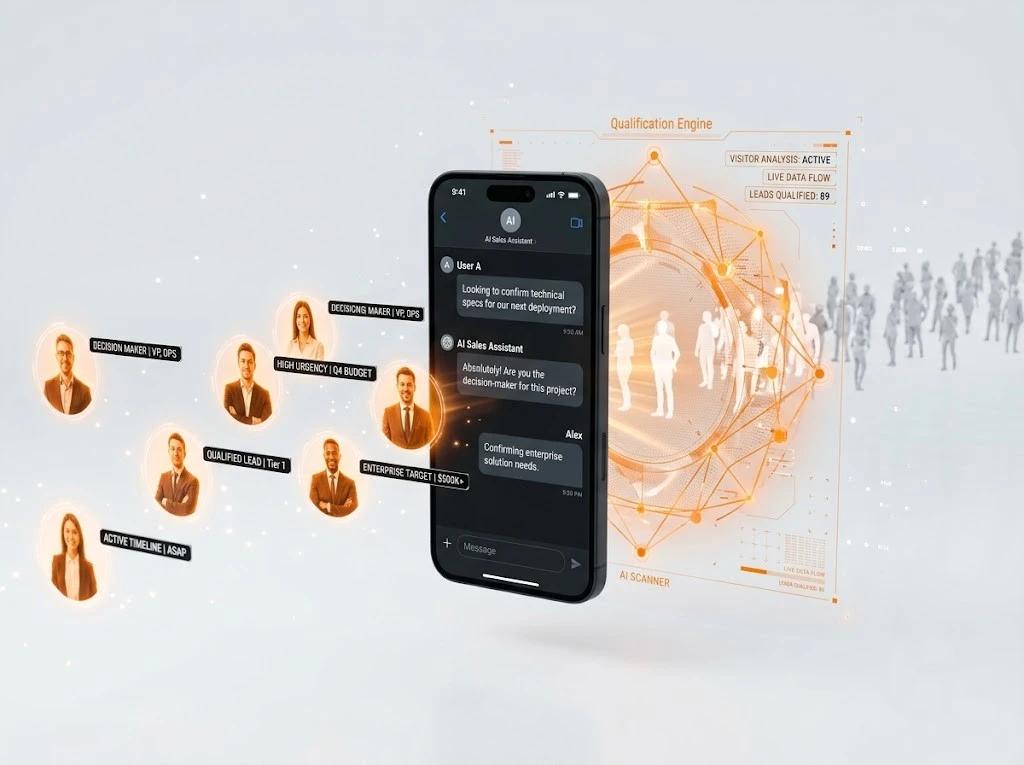
Dynamic Lead Qualification Framework- I designed a flexible qualification system that adapts based on the visitor's responses. The chatbot doesn't just run through a robotic script—it asks contextually relevant questions based on what the user has already told them. If someone mentions they're from a large enterprise, the follow-up questions focus on integration and compliance. If they mention they're a startup, the questions shift to ease of setup and pricing flexibility.
The qualification logic I built assesses multiple signals: urgency indicators ("need this ASAP" vs. "just exploring options"), authority level (are they a decision-maker or just researching?), genuine interest signals, and specific use-case fit. This multi-dimensional scoring ensures the sales team only gets leads worth their time
Frictionless Contact Capture- This was crucial to get right. Traditional chatbots fail because they ask for contact information too early or too aggressively. I engineered the conversation flow to build value first, establish trust, and then request contact information at exactly the right moment—when the user is genuinely interested and wants to continue the conversation.
The system explains why it's asking for information ("Let me connect you with our team who can give you specific pricing for your needs") rather than just demanding an email. It offers choices ("Would you prefer a call or email follow-up?") to give users control. And it validates inputs in real-time, providing friendly error messages if someone mistypes their email
Smart Conversation Routing- Built intelligent routing logic that directs different types of inquiries appropriately. Product questions get answered with relevant information before qualification begins. Technical support requests get routed to support channels. Sales inquiries trigger the qualification flow. This ensures visitors get the right experience based on their actual needs
Backend Architecture- Developed the entire system in Python with a focus on performance and reliability. The backend handles intent classification using natural language processing, manages conversation state across multiple exchanges, generates dynamic responses based on context, and integrates with the client's CRM to push qualified leads automatically.
Implemented comprehensive error handling so the system fails gracefully rather than breaking when something unexpected happens. Added fallback mechanisms for queries the AI can't handle confidently—in those cases, it offers to connect the user with a human rather than making something up
CRM & Sales Integration- Created a seamless integration layer that automatically pushes qualified leads into the client's CRM (Salesforce in this case, but I built it to be adaptable). Each lead entry includes the full conversation transcript, qualification score, identified pain points, urgency level, and preferred contact method.
The system also sends immediate notifications to the sales team when a hot lead comes in—someone who's ready to buy gets flagged for same-day follow-up, while "just exploring" leads go into the nurture queue
User Experience Design- Spent significant time on the conversational UX. Added friendly emoji indicators (🚀 for getting started, 📞 for scheduling calls, ✅ for confirmations) that guide users naturally without being overwhelming. Implemented typing indicators so users know the AI is "thinking," which makes the interaction feel more human. Added quick-reply buttons for common responses to speed up the conversation while still allowing free-text input
Made the entire interface mobile-responsive because a huge portion of website traffic is mobile. The chat widget is lightweight, loads fast, and doesn't impact page performance
Analytics & Optimization Framework- Built comprehensive tracking that monitors conversation metrics: engagement rate (what percentage of visitors interact), completion rate (how many finish the conversation), conversion rate (how many provide contact info), qualification success rate, and common drop-off points.
This data feeds dashboards that help continuously optimize the conversation flow. If lots of people are dropping off at a specific question, that tells us something needs adjustment.
Technical Stack-
- Python 3.11 for backend logic
- Custom NLP pipeline for intent recognition
- State management for multi-turn conversations
- RESTful API architecture for clean integration
- Salesforce API for CRM integration
- WebSocket support for real-time chat
- Email/SMS integration for notifications
- Analytics engine for performance tracking
- Responsive web widget (JavaScript)
- Database for conversation logging
- Security layer for contact data protection
Outcome & Results
The impact on their lead generation was dramatic and immediate. In the first month after deployment, the chatbot engaged 45% of website visitors—people who previously would have just browsed and left. Of those engaged visitors, 62% completed the full conversation and provided their contact information. That's a 3.5x increase in captured leads compared to their old contact form, which was converting at maybe 2-3% of traffic.
But the quality improvement was even more impressive than the quantity. Before the chatbot, their sales team was spending probably 40% of their time on unqualified leads—students doing research projects, competitors snooping around, people looking for free consulting. After implementation, 78% of leads passed through the chatbot were qualified opportunities worth the sales team's time. The sales team went from 20-25 conversations per week (mostly waste of time) to 35-40 conversations where people were genuinely interested and had budget.
The 24/7 availability captured leads they were previously missing entirely. Analysis showed that 28% of qualified leads came in outside normal business hours—evenings and weekends. That's pure incremental revenue that was just evaporating before. The client calculated that these after-hours leads alone justified the entire investment in the system.
Sales efficiency improved dramatically. Because every lead came with full conversation context—what the prospect is interested in, their specific needs, their timeline, their concerns—sales reps could skip the basic discovery phase and jump straight into solution conversations. This cut the average sales cycle from first contact to deal closure by approximately 30%.
Response time went from "whenever someone checks the inbox" (could be hours or days) to literally instant. Prospects got engaged the moment they showed interest. This speed matters enormously—data shows that following up with a lead within 5 minutes vs. 30 minutes increases conversion rates by 10x. The instant engagement created by this chatbot gave them a massive competitive advantage.
Customer feedback on the experience was overwhelmingly positive. People appreciated getting immediate answers to their questions. The conversational tone felt friendly and helpful rather than pushy or robotic. Several prospects specifically mentioned in sales calls that the chatbot experience made them feel confident about the company's tech capabilities.
From a technical reliability standpoint, the system maintained 99.7% uptime over six months. The average conversation completion rate was 68%, which is excellent for lead qualification flows. The intent recognition accuracy sat at 89%—meaning the vast majority of the time, the AI correctly understood what users were asking.
The ROI calculation was clear: if the chatbot generates 40 additional qualified leads per month, and their close rate is 15%, that's 6 extra deals monthly. At their average deal value, the system paid for itself in the first 2 months and has been pure profit since then.