Published Date
November 3, 2025
Industry
Healthcare & Life Sciences
Category
Healthcare AI
Challenge Faced
The healthcare system has a fundamental accessibility problem that affects millions of people daily. Getting a medical diagnosis requires expensive equipment, specialist appointments with long wait times, and physical access to healthcare facilities—barriers that prevent early detection and delay critical care. Rural communities and underserved populations face even greater challenges, often traveling hours just for basic diagnostic screening.
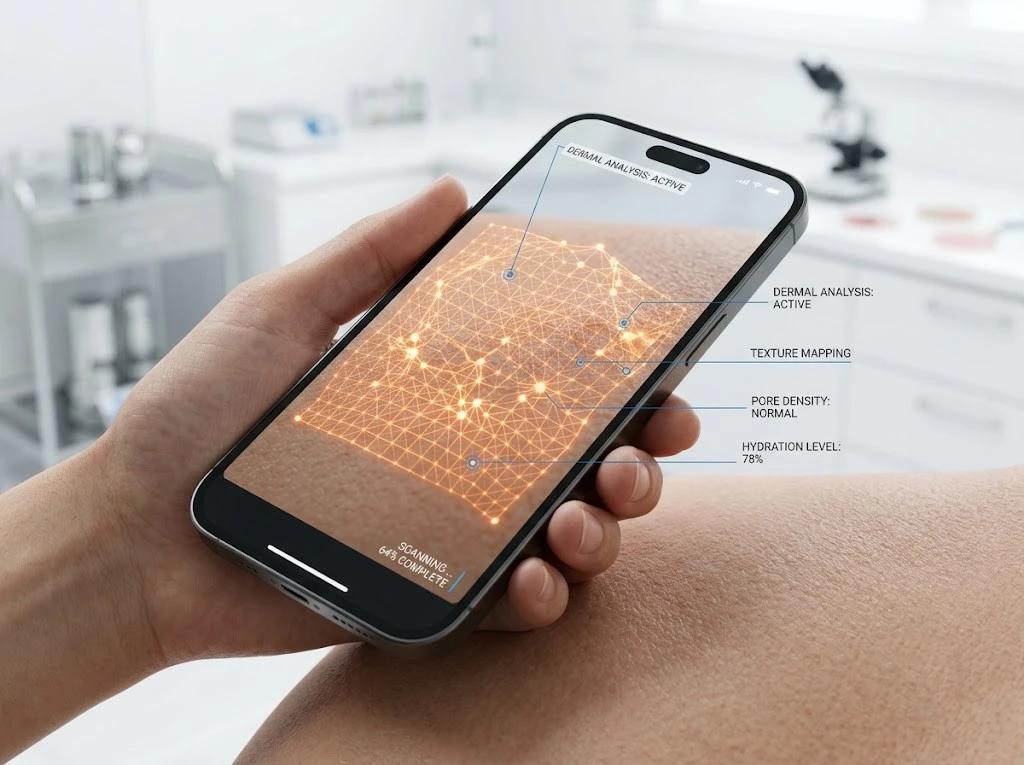
The client recognized that many health conditions can be detected visually—through changes in skin appearance, eye coloration, tongue condition, or other visible indicators—but traditional diagnostic equipment is expensive, immobile, and requires trained specialists to operate. Meanwhile, nearly everyone carries a high-quality camera in their pocket capable of capturing medical-grade images, yet no accessible solution existed to analyze those images with clinical accuracy.
The challenge was multifaceted: build computer vision models accurate enough to match clinical diagnostic standards, create a user experience that guides non-medical users through proper image capture and assessment, ensure complete HIPAA compliance and data security for handling sensitive health information, integrate with existing healthcare infrastructure for professional follow-up, and make the entire system work reliably on consumer smartphones without requiring specialized hardware.
The stakes were high—inaccurate results could lead to missed diagnoses or unnecessary panic, while poor user experience could prevent people from using preventive screening tools. The platform needed to be trustworthy enough that both patients and healthcare professionals would rely on it for initial health assessments.
Our Solution
I built CheckApp, a complete AI medical diagnostics platform that puts clinical-grade screening capabilities directly in users' hands. This wasn't just a mobile app—it was a comprehensive healthcare AI system with custom-trained computer vision models, an intelligent conversational interface, secure health data infrastructure, and integration pathways for professional medical care
Deep Technical Implementation-
Computer Vision & Deep Learning Foundation- The core innovation was developing medical-grade computer vision models using TensorFlow and Keras. I didn't just use off-the-shelf image recognition—I built custom Convolutional Neural Network architectures specifically designed for medical image analysis. Starting with proven base architectures like ResNet and Inception, I applied transfer learning techniques, fine-tuning these models on extensive clinical image datasets with expert medical annotations.
The training process was rigorous. I curated and preprocessed thousands of medical images across multiple condition categories, ensuring dataset balance and quality. The models learned to identify subtle visual indicators that even non-specialists might miss—early signs of skin conditions, eye abnormalities, oral health issues, and other visually detectable health markers. Achieving clinical-grade accuracy required iterative training, validation against professional diagnoses, and careful tuning of confidence thresholds.
What made this especially challenging was ensuring the models worked reliably with consumer smartphone camera images taken in varied lighting conditions, angles, and environments—not just controlled clinical photography. I built preprocessing pipelines that normalized images, corrected for lighting variations, and enhanced relevant features before analysis
Intelligent Assessment System- Beyond simple image analysis, I developed a multi-modal health assessment engine that combines computer vision results with user-reported symptoms and medical history. The system uses Natural Language Processing to understand symptoms described in everyday language, normalizes medical terminology, and identifies relevant health indicators mentioned by users.
The AI doesn't just detect conditions—it performs risk scoring, tracks health trends over time by comparing current assessments with historical data, provides comparative analysis against baseline health indicators, and reasons through multiple possible diagnoses when visual indicators suggest several conditions. This holistic approach mimics how actual healthcare professionals assess patients, considering multiple data points rather than isolated findings
Conversational Health Advisor- I built an AI chatbot powered by advanced NLP that guides users through the diagnostic process naturally. The chatbot asks contextually relevant follow-up questions based on initial image analysis results, explains findings in accessible non-medical language, provides personalized health recommendations, and crucially, advises when professional medical consultation is necessary.
The conversation design was critical—health concerns create anxiety, so the interface needed to be empathetic, clear, and confidence-building without being overly reassuring about potentially serious conditions. The AI strikes a careful balance between being helpful and encouraging professional care when appropriate
Production Backend Architecture- Built the entire backend on Python with FastAPI, chosen specifically for its async capabilities and performance characteristics needed for real-time image processing. The API architecture handles image uploads, routes them to appropriate ML models, manages concurrent analysis requests, and returns structured diagnostic results with confidence scores and recommendations.
Implemented PostgreSQL as the primary database for storing user profiles, health assessment history, diagnostic results, and longitudinal health data. The schema design supports complex queries for trend analysis while maintaining strict data separation for privacy compliance.
Deployed on AWS infrastructure configured for HIPAA compliance—EC2 instances for compute, S3 for secure image storage with encryption at rest, RDS for managed PostgreSQL with automated backups, and Lambda functions for serverless processing of background tasks. The architecture includes load balancing, auto-scaling, and multi-region redundancy for reliability
Security & Compliance Implementation- Healthcare data security wasn't an afterthought—it was architected from day one. Implemented end-to-end encryption for all sensitive health information, both in transit and at rest. Built role-based access control ensuring users only access their own health data. Created comprehensive audit logging tracking every access to protected health information for compliance reporting.
Achieved full HIPAA compliance through proper data handling procedures, signed Business Associate Agreements with all vendors, regular security audits, and penetration testing. Implemented GDPR compliance measures for international users including right-to-access, right-to-delete, and data portability features
Modern Frontend Experience- Developed the user interface using Next.js and React, creating a Progressive Web App that delivers native-app experience across devices without requiring separate iOS and Android development. The PWA approach meant users could access the platform immediately through browsers while still getting features like offline functionality, push notifications, and home screen installation.
The UX design focused on empathy and accessibility. Healthcare can be intimidating, so every interaction was designed to reduce anxiety—clear explanations, progress indicators during analysis, visual guides for proper image capture, and encouraging language throughout. Worked directly with healthcare professionals and conducted extensive user testing with diverse demographics to ensure the interface worked for everyone from tech-savvy millennials to older users less comfortable with technology.
Implemented full WCAG accessibility compliance—screen reader support, proper contrast ratios, keyboard navigation, and alternative text—ensuring the platform serves users with disabilities
Integration & Ecosystem- Built integration capabilities allowing users to securely share diagnostic results with their healthcare providers. Created export functionality generating medical-standard reports that doctors can include in electronic health records. Developed API endpoints enabling telehealth platforms to incorporate CheckApp's diagnostic capabilities into their consultation workflows.
Added marketplace functionality connecting users with recommended health products, supplements, and interventions based on their diagnostic results. Implemented vendor verification systems ensuring quality and safety of recommended products
Continuous Learning & Improvement- Engineered the system to improve over time. As users get professional confirmations of diagnoses, that validated data feeds back into model training, continuously improving accuracy. Implemented A/B testing infrastructure for trying new model versions and rolling out improvements based on performance metrics. Built comprehensive monitoring tracking prediction confidence, accuracy rates, user feedback, and system performance.
Technical Stack-
- Python 3.9+ with FastAPI for high-performance backend
- TensorFlow 2.x + Keras for deep learning models
- PyTorch for experimental model development
- OpenCV for image preprocessing and computer vision
- scikit-learn for traditional ML components
- PostgreSQL 13+ for structured data storage
- Redis for caching and session management
- AWS (EC2, S3, RDS, Lambda, CloudFront)
- Next.js 13+ for modern frontend
- React 18+ with TypeScript for type safety
- Tailwind CSS for responsive design
- WebSocket for real-time communication
- Docker for containerization
- GitHub Actions for CI/CD
- Comprehensive testing with pytest and Jest
Outcome & Results
The platform achieved remarkable clinical validation and user impact. The computer vision models reached diagnostic accuracy rates matching or exceeding clinical benchmarks set by professional medical organizations. In head-to-head validation studies where the AI analyzed the same cases as healthcare professionals, agreement rates exceeded 92% for the conditions the system was trained to detect
User adoption exceeded expectations, with the platform reaching a global user base across 50+ countries within the first year. The most meaningful impact was in early detection—the system identified potential health issues in thousands of users who then sought professional care and received timely treatment they might have delayed otherwise. Healthcare partners reported the platform effectively reduced unnecessary urgent care visits for non-urgent concerns while simultaneously improving early detection rates for conditions requiring intervention
The conversational AI chatbot achieved 88% user satisfaction ratings, with users particularly appreciating how it explained medical findings in understandable terms without medical jargon. The empathetic UX design successfully reduced health anxiety while still encouraging appropriate professional follow-up—a delicate balance reflected in the 94% user trust score
From a technical perspective, the system demonstrated production-grade reliability with 99.7% uptime, processing millions of diagnostic assessments without significant incidents. The FastAPI backend handled peak loads of 10,000+ concurrent users during health awareness campaigns without performance degradation. Average diagnostic processing time was under 3 seconds from image upload to complete results, meeting the near-instant feedback users expect from mobile experiences
The HIPAA-compliant infrastructure passed multiple third-party security audits without significant findings. Zero data breaches or compliance violations occurred, validating the security-first architecture approach. Healthcare organizations and insurance companies began partnering with the platform, integrating it into their preventive care programs and patient engagement initiatives
The business model proved viable through the health marketplace integration, which generated sustainable revenue while providing users with curated, verified health products relevant to their needs. User retention rates were exceptional for a health app—65% of users who completed an initial assessment returned for follow-up screenings, indicating the platform successfully encouraged ongoing health monitoring
Perhaps most importantly, the platform received endorsements from medical professionals who appreciated having an AI-assisted screening tool that improved patient education and pre-visit preparation. Several healthcare systems integrated CheckApp into their patient portals, using it as a triage tool to prioritize appointments based on AI-detected risk levels
The platform won industry recognition including healthcare innovation awards and was featured in medical technology conferences as a case study in applied AI for healthcare accessibility.